Why Resume Matching Is Dead: The Rise of Skill-First Hiring in 2026
A recruiter-focused look at why resume keywords are failing and how skill-first hiring is reshaping talent decisions in 2026.
In this article: Why Resume Matching Is Dead: The Rise of Skill-First Hiring in 2026.
Parth Bhatt
Co-Founder, UmEmployed
Why Resume Matching Is Dead: The Rise of Skill-First Hiring in 2026
For decades, resumes acted as proxies for talent.
They were never perfect—but they were “good enough” in a world where careers were linear, job titles were standardized, and skills evolved slowly over time. Recruiters could reasonably assume that someone with the right title and company background had the capability needed for the role.
That world no longer exists.
As we move into 2026, recruiters are watching the cracks widen.
Job titles mean different things across organizations.
Career paths zigzag across industries.
High-performing candidates often look unconventional on paper—while perfectly formatted resumes fail to predict on-the-job success.
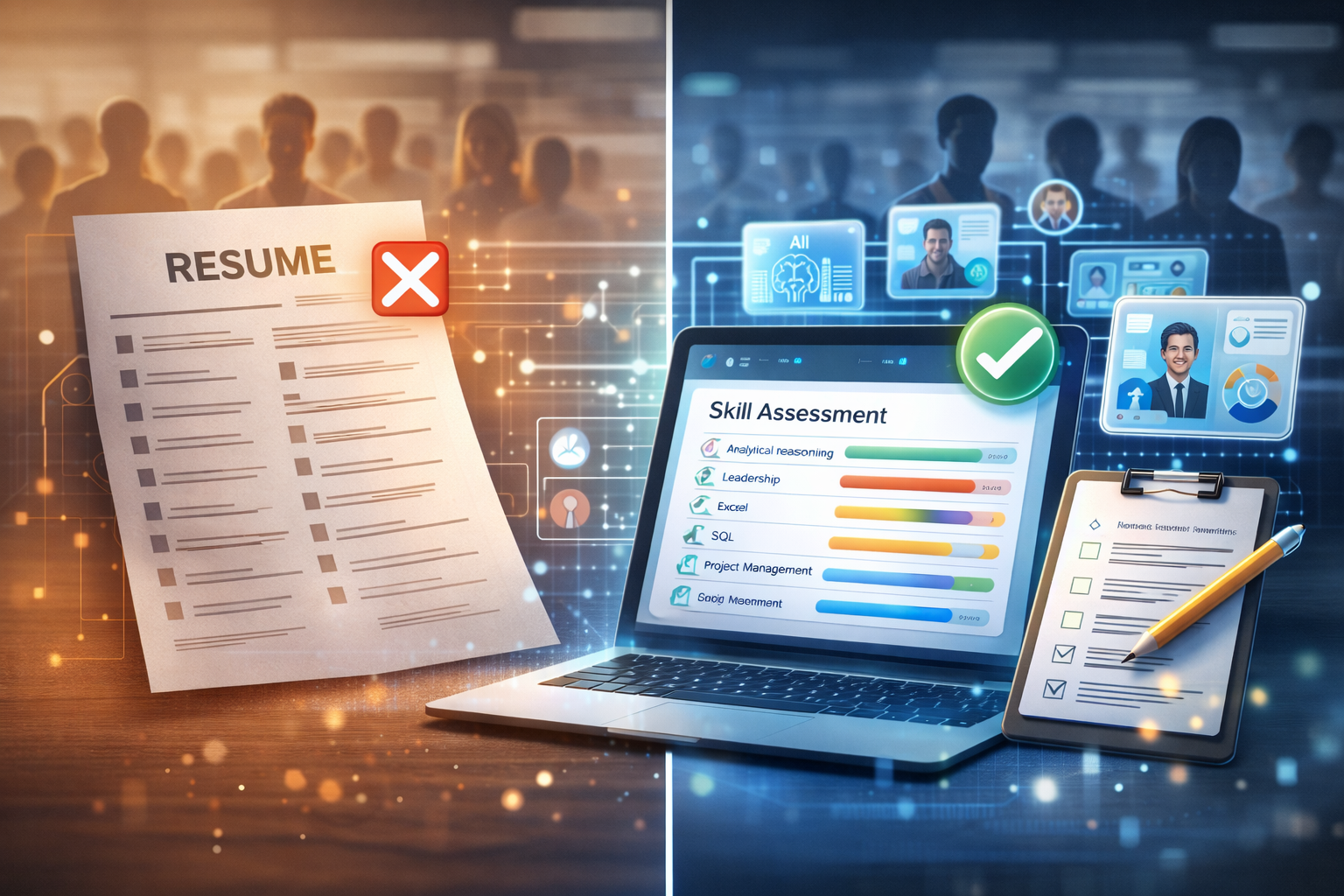
This is why skill-first hiring is replacing resume matching.
🧠 Why Resume Matching No Longer Works
Resume matching relies heavily on:
- Keyword alignment
- Job titles
- Company names
- Chronological career paths
But modern talent doesn’t fit neatly into those boxes.
Today’s candidates:
- Build skills outside traditional roles
- Learn continuously through projects and self-study
- Transition across industries
- Deliver impact without “perfect” resumes
The result?
Recruiters miss strong candidates—and spend too much time reviewing weak ones.
🔄 The Shift from “Where You’ve Been” to “What You Can Do”
Skill-first hiring changes the entire evaluation model.
Instead of filtering candidates based on past titles, recruiters now focus on:
- Demonstrated skills
- Problem-solving ability
- Learning agility
- Role-specific performance
AI-driven screening tools extract skills directly from:
- Resumes
- Portfolios
- Work samples
- Assessments
Then those skills are validated, not assumed.
This creates a more accurate, fair, and future-ready hiring process.
🧪 How Skill Validation Improves Hiring Outcomes
When skills are tested and verified:
- Shortlists become stronger
- Interviews become deeper
- Hiring decisions become clearer
- Bias tied to pedigree is reduced
Recruiters stop overlooking capable candidates simply because their resume doesn’t fit a predefined mold.
Hiring becomes evidence-based—not assumption-based.
🚀 What This Means for Recruiters in 2026
In 2026:
- Resumes still exist
- Keywords still appear
- Job titles still matter a little
But they no longer decide outcomes.
Skills do.
Recruiters who embrace skill-first hiring will:
- Move faster
- Hire more accurately
- Reduce mis-hires
- Expand their talent pool
- Gain credibility with hiring managers
Those who rely only on resume matching will continue to struggle with noise, delays, and missed talent.
📌 The Bottom Line
Resume matching is no longer enough.
Skill-first hiring reflects how people actually work, learn, and grow in 2026.
Platforms built around real skill verification—like UmEmployed—aren’t just improving hiring.
They’re redefining it.
The future of recruiting isn’t about finding the best resume.
It’s about identifying the right skills—in real time.
About Parth Bhatt
Co-Founder, UmEmployed
Parth Bhatt is a passionate professional with extensive experience in their field. They share insights and practical advice to help others succeed in their careers.